
Protected species on the railway
Railway corridors are often some of the most continuous habitat left in a fragmented landscape. Scrub, hedgerow, woodland edge, embankments, rough grassland, watercourses, bridges and mature trees can all support protected species, and those constraints often sit directly where vegetation management, fencing, drainage or renewals need to happen.
BlueJay helps rail teams turn a potential protected-species constraint into a clear delivery route. We assess the habitat, evidence, work method, season and scheme requirements, then set out the proportionate solution: redesign or avoidance, a precautionary method, targeted survey, licensed mitigation or ecological supervision. Early decisions allow survey, licence and possession lead times to be planned properly and keep the programme moving.
Hazel dormice
Dormice are one of the most important constraints on lineside vegetation work across southern England. Suitable scrub, hedgerow and woodland edge can extend for long distances, making a simple presence-or-absence survey strategy impractical for some work banks. The delivery question is often how the vegetation can be managed lawfully while maintaining the habitat features and connectivity that matter.
BlueJay can assess and grade dormouse habitat, review previous records and surveys, advise on the appropriate avoidance or licensing route, write the PWMS and toolbox talk, provide licence-holder or accredited-agent supervision and maintain the daily records needed during clearance. Where Network Rail’s applicable dormouse way of working, including NR/GN/ESD50 where required, is being used, we translate it into the section-specific work controls rather than simply citing the guidance.
Depending on the programme and question, we can also undertake nest-tube or footprint-tunnel surveys. Where survey evidence will change the delivery decision, we design it around that question. Where suitable habitat and project requirements already support assumed presence and a controlled working method, we can take that route directly.
Badgers
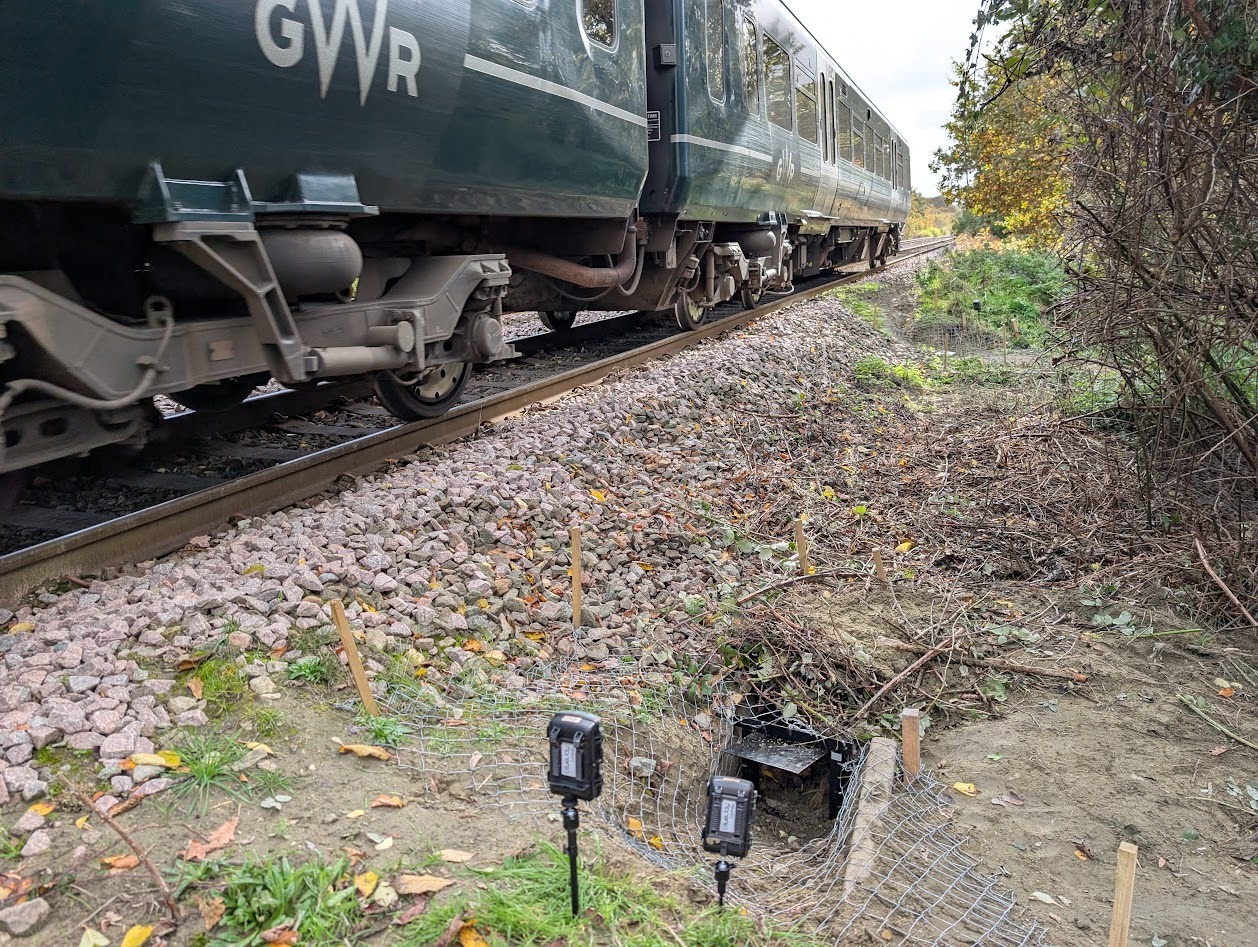
Railway cuttings, embankments and fence lines can provide suitable sett habitat, and badger constraints often become apparent once clearance or ground works are being planned. BlueJay surveys sett extent and activity, deploys trail cameras where status or use needs to be established and advises first on whether the design or method can avoid interference.
Where a sett cannot be avoided, we can manage the ecological work through the appropriate licence route, including method statements, artificial-sett design and construction input, one-way-gate exclusion, daily checks, camera monitoring and completion records. We also coordinate the vegetation and other protected-species controls needed to access or construct the mitigation, so solving the badger issue does not create a second ecological problem.
Bats in trees, structures and railway buildings
Potential bat roost features occur in mature lineside trees, bridges, culverts, headwalls, buildings and other structures. We carry out Preliminary Roost Assessments and Ground Level Tree Assessments, then arrange or undertake closer inspection, endoscope work, activity surveys, static-detector deployment, thermal imaging or infrared recording where the feature warrants it.
The advice is tied to the proposed work. If a tree is being felled, the contractor needs to know whether the feature can be inspected further, whether survey is seasonally required, whether a licence is likely and what felling method is appropriate. If a structure is being repaired, the relevant question is which part will be affected and what evidence is needed before the works begin.
Lighting is also part of the bat constraint. For compounds, access routes, structures and permanent installations we can advise on sensitive lighting and retained dark corridors, drawing on current good practice and Network Rail guidance such as NR/GN/ESD26 where applicable.
Nesting birds and Schedule 1 species
Pre-clearance bird checks are a routine part of railway vegetation work, but they need enough time, access and competence to be meaningful. Dense scrub, bramble, ivy and tree canopies cannot be signed off by walking past them immediately before the machine starts.
BlueJay carries out pre-clearance checks and records, including the Network Rail NR/GN/ESD29 breeding-bird and nest-check process where it is required by the project. Where an active nest is found, we identify the affected habitat and disturbance risk, establish a suitable exclusion and advise when the work can be reviewed for recommencement. Unaffected work can continue where it remains lawful and consistent with the method.
Where Schedule 1 birds are a realistic possibility, the additional disturbance protections have to be considered. We can review records and habitat, plan survey or watching briefs and incorporate the relevant Network Rail Schedule 1 guidance, including NR/GN/ESD27 where applicable.
Reptiles
Railway embankments, rough grassland, ballast margins, scrub edges and unmanaged access land can provide good reptile habitat. BlueJay undertakes habitat assessment, presence and population surveys where they are needed, and designs practical mitigation around the proposed works.
That can include staged vegetation reduction, reptile fencing, capture and translocation, destructive searches and ECoW. On heathland routes we can also advise on smooth snake and sand lizard constraints. As with other species, we look first for changes to the work footprint or sequence that remove unnecessary risk before recommending a lengthy mitigation programme.
Great crested newts and amphibians
Where ponds and suitable terrestrial habitat fall within the likely zone of influence of railway works, we assess habitat suitability and connectivity and advise on the survey or licensing route. Depending on the project, that can include eDNA, conventional survey, district-level licensing where available, a conventional European Protected Species licence, trapping and exclusion, destructive search or a precautionary method for low-risk works.
The rail context matters because compounds, access tracks, drainage works and small excavations can create terrestrial impacts even when the main engineering work is some distance from a pond. We assess the actual pathways rather than applying a fixed radius as though every site were the same.
Water vole, otter and watercourse species
Culvert renewal, headwall work, drainage, ditch clearance and bank works bring riparian species into scope. BlueJay surveys the relevant watercourse reach, records evidence of water vole and otter and advises on bank disturbance, vegetation removal, in-channel working, dewatering, access and pollution-control interfaces.
Where a protected feature cannot be avoided, we can support the appropriate licence, displacement or mitigation route and provide ECoW for the works. Where the species constraint can be removed through timing or a small change in method, that is usually the first option we explore.
Designated sites and sensitive habitats
Protected species do not sit in isolation from the wider site. Railway work may also affect SSSIs, SACs, SPAs, Ramsar sites, ancient woodland, priority habitat or other sensitive areas. BlueJay can assess the relationship between the proposed work and the designated feature, provide HRA information where relevant and support the ecological evidence needed for consents and project approvals.
Invasive species and biosecurity
Japanese knotweed and other invasive plants can affect clearance, excavation, access and disposal. We provide survey, mapping and ecological advice on working methods and biosecurity, including Network Rail’s Japanese knotweed guidance under NR/GN/ESD35 where it applies. The practical aim is to keep the work moving without spreading the problem along the railway or into adjacent land.
Licensing, avoidance and delivery
The best protected-species strategy is the one that is lawful, proportionate and deliverable. Sometimes that is a licence. Sometimes it is a small design change, a seasonal adjustment or a carefully written precautionary method. We make that decision early enough for the survey window, licence lead time, possession plan and contractor documentation to work together.
Where licensing is required, BlueJay can support the application, mitigation design, licence method, accredited or licensed field team, site records and completion requirements. Where avoidance is used, we write the controls just as carefully, because an avoidance method only works if the people delivering it understand exactly what they can and cannot do.
An unusual species does not need to become a major stoppage
Rail work often produces local ecological issues outside the standard list: Roman snails, hedgehogs in brash, amphibians in drainage features, uncommon plants or a new species finding during access. We can investigate the issue, establish the legal and ecological significance and provide a proportionate technical note or working method. The aim is to protect the feature, establish proportionate controls and give the contractor a defensible route forward.
Common questions
No. The answer depends on the proposed activity, habitat, evidence, project requirements and whether the relevant offences can be robustly avoided through an approved way of working. We identify the proportionate route for the scheme, whether that is survey, a controlled method or licensing.
Yes, where the statutory and licensing requirements are met. We can cover status assessment, camera monitoring, mitigation design, licence documentation, artificial-sett input, exclusion, daily checks, ECoW and completion records.
The affected work stops, the nest and appropriate surrounding habitat are protected, and the exclusion is reviewed according to the species, stage and disturbance risk. Work outside the affected area may continue where it remains lawful and consistent with the method.
Yes. We review the existing evidence, current site condition and proposed works first. We can then continue the survey, method, licensing or field delivery where the information supports it, or identify the targeted update needed before responsibility is transferred.

