
Rail ECoW and possession working
When an ecological method depends on somebody being there while the work happens, that person needs to understand both the ecology and the railway. BlueJay provides PTS and DCCR-trained Ecological Clerks of Works for day shifts, nights, line blocks, possessions and blockades, with licensed and species-specific cover matched to the job.
Our ECoWs remain with the operation whenever the method requires supervised working. They agree the work limits with the supervisor, release or hold sections, observe the approved method, stop the affected activity when a trigger is met and complete the record afterwards. For tasks requiring only a pre-start check or defined hold point, attendance is structured around that requirement.
ECoW that fits the work package
Not every job needs the same attendance. A high-risk protected-species clearance may require continuous supervision. A small installation may need a pre-start check and release. A long work bank may be more efficiently managed through defined sections and hold points. We review the ecological method, work sequence and programme before recommending how the attendance should be structured.
That helps the contractor resource ecology properly. It avoids paying for continuous cover where the method does not require it, but it also avoids the opposite problem: booking an ecologist for a short visit when the approved method actually requires supervision throughout the activity.
What happens on a typical shift
Before access
The ecologist reviews the latest work package, ecological method, licence or consent conditions and the exact work limits. Any mismatch between the documents and the planned activity can then be raised before the team is standing trackside waiting for an answer.
Briefing and pre-start inspection
The ECoW joins the relevant site briefing, confirms how the ecological controls will be communicated and checks the accessible work area for the features covered by the method. Depending on the job, that may include active bird nests, protected animals, sett activity, potential bat features, exclusion zones, watercourse conditions, invasive plants or changes in habitat since the previous shift.
Release, hold points and supervision
Areas that can proceed are released clearly. Areas that cannot are identified and held. Where the method requires continuous supervision, the ecologist remains with the cutting, felling, excavation, installation or other relevant activity. Where the method uses defined hold points, the supervisor knows exactly when the ecologist must return before the next stage starts.
Unexpected finds and stop-work
If a trigger is met, the affected activity is stopped and the ecological feature protected while the next step is established. The response should be proportionate. A local nest, animal or unexpected feature does not automatically mean stopping every activity on a possession, but it does require the affected work to remain controlled until the legal and ecological position is clear.
Record and handover
At the end of the shift we record what was checked, what was released or held, any finds or incidents, photographs and actions for the following shift. Where different ecologists are rotating through a programme, a clear handover prevents the next person having to reconstruct the site history at the start of the night.
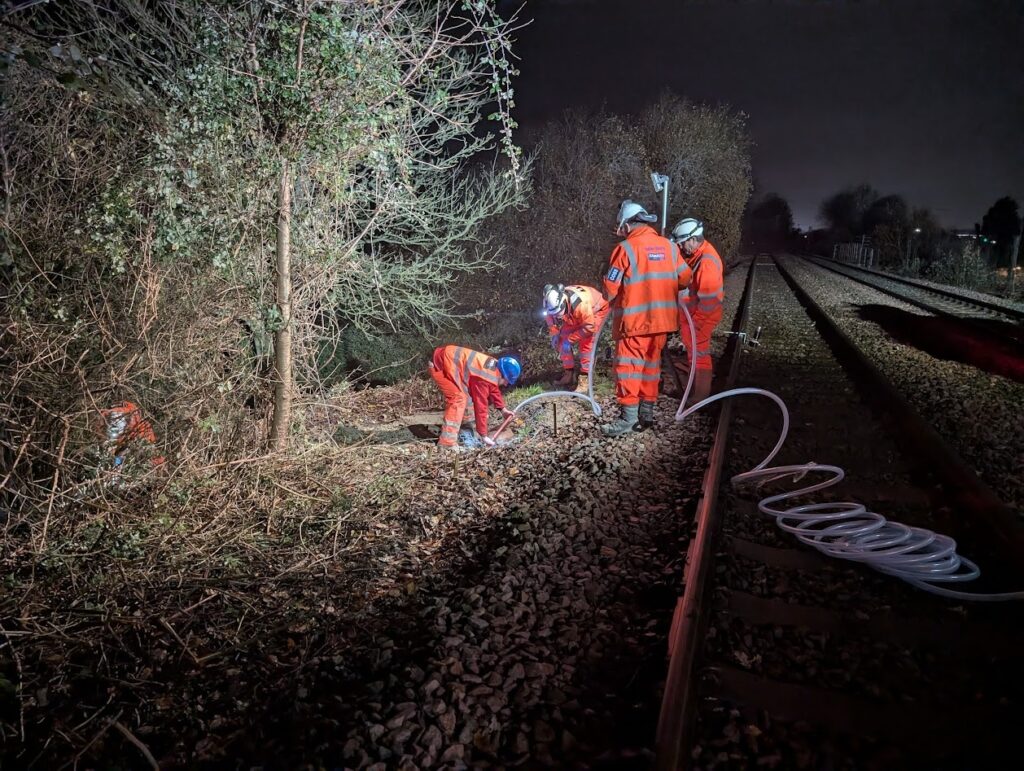
The work we supervise
BlueJay provides ECoW and ecological supervision across a wide range of railway activities, including:
Dormouse and other licensed cover
Licensed and protected-species work is matched to the competence the method requires. For dormouse schemes, BlueJay can provide licence-holder or appropriately appointed accredited-agent cover where required by the approved method. Where Network Rail’s current dormouse way of working, including NR/GN/ESD50 where applicable, forms part of the project controls, the ECoW works to that method and the scheme-specific requirements built around it.
Badger closures, bat work, great crested newt tasks and other licensed activities are likewise assigned according to the licence and work being undertaken. Where a task needs technical oversight as well as field attendance, we can provide both rather than leaving the site ecologist to make programme-level decisions alone.
Breeding-bird and pre-clearance checks
Vegetation work during the nesting period often needs more than a generic “bird check”. BlueJay can carry out the pre-clearance assessment and records required by the project, including the Network Rail NR/GN/ESD29 breeding-bird and nest-check process where applicable. Where Schedule 1 species are a realistic risk, the approach can also take account of the relevant Network Rail guidance and the additional disturbance considerations that apply.
If an active nest is found, we identify and protect the affected area, advise on a suitable exclusion and review when work can resume. Unaffected activities can continue where that remains lawful and compatible with the approved method.
Possession and blockade survey teams
Sometimes the possession is for survey rather than delivery. BlueJay can supply multi-ecologist teams to inspect long routes, grade habitat, check structures or trees and collect consistent photographs and GIS data while access is available. The survey is scoped around the decision that needs to follow, so the output can be used to divide the subsequent work bank, plan licences or set the ecological attendance pattern.
Programme cover, not just individual shifts
For larger vegetation, fencing or installation programmes, we can build a rota around the planned work bank and maintain continuity across multiple sites and shifts. That includes named technical oversight, standardised daily records and a process for feeding new findings back into the planner and document set.
Rail programmes move. Possessions change, line blocks are cancelled and sites can come forward unexpectedly. We maintain a pool of rail-ready ecologists and licensed associates and can support shorter-notice work where the location, competence requirements and existing bookings allow. Early sight of the work package helps us confirm realistic cover and match the right ecologist to the shift.
Support for other ecological consultancies
BlueJay also provides rail-qualified field resource to other ecology consultancies. If you hold the client relationship and technical lead but need a PTS/DCCR ecologist, licence-holder capacity or a small team for possession access, we can work under your method and reporting format while keeping the commission structure and client relationship clear.
What we need from you
A confirmed shift is easier to resource when the scope is clear. Send the date and expected times, meeting point, ELR and mileage or site location, work description, current TBS/WPP, ecological method or licence requirements, access arrangements and any project-specific competencies or reporting requirements. If some of that is still being finalised, send what you have and we can identify the gaps.
Common questions
Normally the ecologist works within the contractor’s access arrangements and the project provides the COSS. If the access arrangement is different, that should be agreed at booking so the correct resource is planned.
One ecologist can cover two gangs only where the locations, visibility, communication and ecological method allow genuine supervision. Where simultaneous supervised operations cannot be covered properly, we recommend separate attendance.
Yes, subject to availability and the required competencies. We support both individual shifts and longer programmes. Sending the documents with the booking allows us to confirm the competence needed and match the right ecologist to the shift.
Yes. Our normal output is a concise daily ecological record, with weekly summaries, incident reports or scheme-level close-out reporting added where the contract requires it.

